






3 Ways to Create a DTF Gang Sheet: Photoshop, Illustrator & Canva

Creating your own DTF gang sheet gives you more control over design size, placement, quantity, and available sheet space.
If you prefer to prepare the entire layout yourself, Adobe Photoshop, Adobe Illustrator, and Canva are three common tools you can use to create a print-ready gang sheet.
In this guide, we’ll show you how to create a 22-inch-wide DTF gang sheet using each of these tools, along with a few important setup tips to help you avoid sizing and resolution problems.
If you prefer not to arrange every design manually, you can also use the Sam’s DTF Gang Sheet Builder for a faster online workflow.
A DTF gang sheet combines multiple designs, sizes, quantities, or repeated copies of artwork onto one larger sheet of transfer film.
For example, a single gang sheet can include:
The goal is to use the available sheet space efficiently while keeping each design at the correct print size.
At Sam’s DTF Transfers, gang sheets use a 22-inch print width, while the sheet length depends on the size selected when ordering.
Photoshop is a good option if your artwork is already in PNG or raster format.
Open Photoshop and create a new file.
Set the width to:
22 inches
Then set the height to match the gang sheet length you plan to order.
For example:
Use:
300 DPI whenever possible
Work with a transparent background instead of a white background.
This helps preserve transparency around your artwork when the final PNG is exported.
Place or paste your design files into the Photoshop document.
Make sure each design is already close to the size you want it printed.
Avoid enlarging small, low-resolution images because increasing the physical dimensions does not create additional image detail.
Turn on:
This makes it easier to move and resize individual designs.
Enable Smart Guides and Snapping to help keep designs aligned and organized.
These tools can make it easier to create clean rows and reduce wasted space.
Position your artwork across the sheet.
You can:
If you plan to cut the transfers individually, leave enough spacing between designs for comfortable trimming.
Before exporting, double-check:
The final file dimensions should match the gang sheet size you intend to order.
Once the layout is complete, export the gang sheet as a high-quality PNG with transparency preserved.
Illustrator is especially useful if your artwork is vector-based.
Set the artboard width to:
22 inches
Set the height to match the gang sheet length you plan to purchase.
Place your vector or raster artwork into the document.
Make sure each design is set to the correct final print dimensions.
You can switch to Outline View using:
Command/Ctrl + Y
This can make it easier to see object boundaries when arranging multiple designs closely together.
Move, rotate, duplicate, and organize your artwork to use the available space efficiently.
Maintain enough spacing between designs if they will be cut apart after printing.
Before export, verify that the artboard matches the exact gang sheet dimensions you plan to order.
Export the finished artwork as a high-quality PNG.
For a 22-inch-wide sheet at 300 DPI, the width is:
6600 pixels
Make sure transparency is preserved if your designs require transparent backgrounds.
Canva can be a convenient option for users who do not work in Photoshop or Illustrator.
Go to Canva and create a custom design.
Set the width to:
22 inches
Set the height to the gang sheet length you plan to order.
Upload your PNG or other supported artwork files.
Add them to the canvas and resize them carefully.
Canva may initially place uploaded images larger than their intended print dimensions, so always check the final size.
Move and rotate designs to use the available space efficiently.
Try to keep similar sizes grouped together when possible.
If you need multiple copies of the same logo or graphic, use Canva’s duplicate feature instead of uploading the same artwork repeatedly.
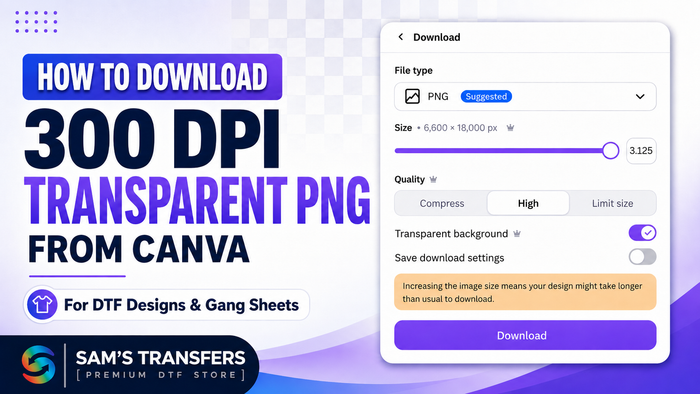
When the layout is complete, download the gang sheet as a PNG with a transparent background.
A Canva plan that supports transparent PNG export may be required.
A large Canva canvas does not automatically guarantee that every uploaded design is high resolution.
If the original artwork is small or blurry, enlarging it inside Canva will not create new detail.
Before ordering, inspect the final artwork at the intended print size.
If you need help exporting artwork correctly, see our guide on How to Download a 300 DPI Transparent PNG from Canva for DTF Printing.
Creating a gang sheet manually gives experienced designers full control over artwork placement and layout.
Photoshop, Illustrator, and Canva can all work well when you already know the exact dimensions and quantities you need.
However, you do not need professional design software to order a gang sheet.
If you have individual artwork files and want an easier workflow, the Sam’s DTF Gang Sheet Builder lets you upload designs, choose sizes and quantities, arrange artwork, and prepare your sheet online.
For a step-by-step walkthrough, see our How to Build a DTF Gang Sheet Online guide.
If your gang sheet is already completely prepared in Photoshop, Illustrator, Canva, or another design program, you can skip the builder and order through Upload-Ready DTF Gang Sheets.
Choose the method that best fits your workflow.
Photoshop is a strong option for PNG and raster artwork.
Illustrator is ideal for vector artwork and precise object sizing.
Canva can be useful for simpler layouts and users who prefer an easier design interface.
Gang Sheet Builder is the easiest option when you have separate artwork files and do not want to build the full sheet manually.
Upload-Ready Gang Sheets are best when the entire sheet has already been designed and sized correctly.
Photoshop, Illustrator, and Canva can all be used to create a print-ready DTF gang sheet when you want full control over the layout.
Whichever method you choose, focus on the same fundamentals:
If you prefer not to arrange every design manually, the Sam’s DTF Gang Sheet Builder provides a faster online workflow.
If your gang sheet is already completely prepared, simply upload the finished file through the Upload-Ready DTF Gang Sheets option.
Join our newsletter for guides, new designs and shop-growth ideas — a few great reads each month.


Comments (0)
Be the first to leave a comment.
Leave a Comment