





Benefits of DTF Transfers for Custom Apparel Businesses

Custom apparel businesses need a printing method that can handle different designs, different order sizes, multiple garment colors, and tight production schedules without making every job unnecessarily complicated.
That flexibility is one of the biggest reasons DTF transfers have become useful for T-shirt businesses, print shops, clothing brands, schools, teams, embroidery shops, and other custom apparel operations.
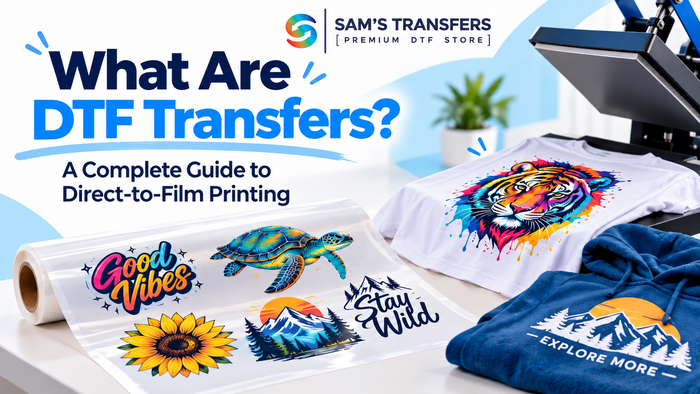
DTF, or Direct-to-Film, transfers allow full-color artwork to be professionally printed onto transfer film and then applied to garments with a heat press.
Instead of producing every design directly on a garment, businesses can order ready-to-press transfers and apply them as needed.
That creates several practical advantages for a growing custom apparel business.
One of the biggest benefits of DTF transfers is the ability to reproduce full-color artwork without building separate screens for every color.
DTF is well suited for:
For a business handling many different customer designs, this can simplify production significantly.
A six-color design does not require six separate screens simply because it contains six colors.
This makes DTF especially useful when customers frequently submit detailed or colorful artwork.
It also helps apparel businesses offer more design flexibility without changing the production method every time the artwork becomes more complicated.
Custom apparel businesses rarely receive only one type of order.
One customer may need six shirts.
Another may need fifty.
A school may need multiple designs in different quantities.
A business may reorder the same employee logo throughout the year.
DTF transfers can fit all of those situations.
There is no need to create a traditional screen setup every time a customer orders a small quantity.
That makes DTF particularly useful for:
The same basic transfer workflow can also be scaled for larger orders.
For businesses that receive a mix of small, medium, and bulk jobs, that flexibility can make production planning easier.
Traditional printing methods can require additional setup as artwork becomes more complicated.
DTF handles much of that complexity during the digital printing stage.
For the apparel shop applying ready-to-press transfers, there are no individual screens to expose and register and no vinyl elements to weed for a detailed multi-color design.
The transfer arrives ready for heat application.
This can reduce the amount of preparation required before pressing garments.
For businesses that outsource their DTF production, the required in-house equipment can also be relatively simple.
The business can focus on:
while the DTF supplier handles the transfer printing process.
This is particularly useful for businesses that want to sell full-color printed apparel without operating their own DTF printer.
Speed matters in custom apparel.
Rush business orders, school events, team orders, seasonal designs, customer deadlines, and last-minute reorders can all put pressure on production schedules.
Ready-to-press DTF transfers can simplify the workflow.
Once the transfer is available, the basic production process becomes:
There is no need to rebuild the artwork or prepare multiple screens before every application.
For shops processing many different jobs, this can make switching between customer orders much easier.
The speed advantage does not come simply from the printing technology itself.
The larger benefit is the ability to keep the apparel production workflow simple once the transfers have been produced.
DTF transfers can be applied to many commonly used apparel fabrics, including:
They are widely used for products such as:
This gives apparel businesses more flexibility when customers request different garment styles.
A business does not have to restrict every design to one type of shirt.
However, different fabrics can respond differently to heat.
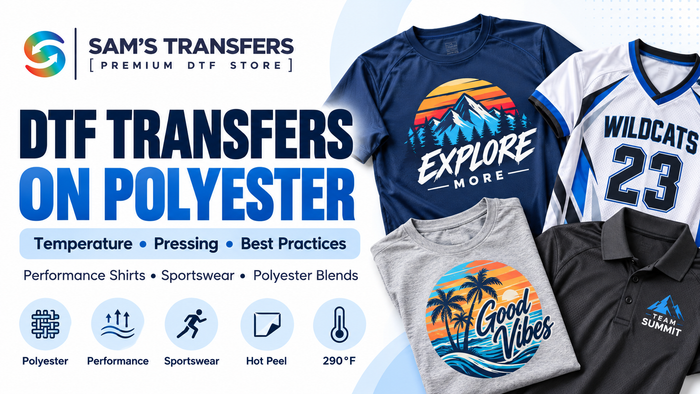
Polyester and performance fabrics, for example, may require additional attention to temperature, pressing time, and dye migration.
For those garments, use fabric-specific pressing guidance rather than assuming every product should use exactly the same settings.
Personalization is an important part of custom apparel.
Customers may request:
DTF makes it easier to handle many of those variations.
Unlike heat-transfer vinyl, detailed DTF artwork does not normally require individual elements to be weeded before pressing.
This can be particularly helpful when a design contains:
For businesses producing many different designs, avoiding a labor-intensive weeding process can make the workflow easier to manage.
One of the less obvious benefits of DTF transfers is inventory flexibility.
A business does not always need to decorate every garment in advance.
Instead, it can keep blank apparel and transfers separately and press the finished product when an order is received.
For example, a business might stock:
while keeping the corresponding transfers ready for production.
When the customer places an order, the business can choose the correct blank garment and apply the transfer.
This can be useful for:
It can also reduce the risk of decorating a large amount of inventory in the wrong sizes before the actual customer demand is known.
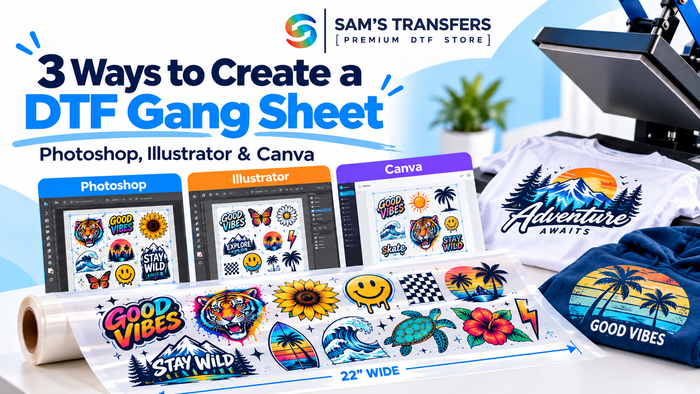
For businesses ordering multiple transfers, gang sheets can make DTF production even more efficient.
A gang sheet allows multiple designs or multiple copies of a design to share a larger printed sheet.
For example, one gang sheet might include:
Instead of leaving unused space, businesses can arrange artwork to make better use of the sheet.
This is especially valuable for shops producing many different designs or garment placements.
There are two common ways to order them.
A DTF Gang Sheet Builder allows the customer to arrange designs online.
An Upload-Ready Gang Sheet is useful when the full gang sheet has already been prepared at the correct dimensions.
The best method depends on how the business creates and organizes its artwork.
Launching a new apparel design always involves some uncertainty.
Will customers like it?
Which garment color will sell best?
Which sizes will move fastest?
How many should you produce?
Because DTF works well for small quantities, businesses can test a design before producing a large amount of finished inventory.
For example, an apparel brand could launch:
and then reorder the designs that sell.
This is useful for brands that want to test demand without committing to a large decorated inventory immediately.
It can also help businesses experiment with seasonal designs, events, trends, and limited releases.
DTF is not necessarily a replacement for every printing method.
For many print shops, its biggest advantage is that it adds another production option.
A screen printer may receive a job with:
That particular job may not be efficient to put through the normal screen-printing workflow.
DTF provides another way to produce it.
This allows print shops to choose the production method that fits the job rather than forcing every order through the same process.
Screen printing can still make sense for certain larger, repeat production runs.
DTF can handle many of the jobs where flexibility and artwork complexity matter more.
The two methods can work together inside the same apparel business.
Repeat business is important for custom apparel companies.
A local business may order employee shirts several times throughout the year.
A school may reorder club shirts as new students join.
A brand may need another small batch after a design sells out.
When the artwork is already prepared, another set of DTF transfers can be ordered without rebuilding a traditional screen setup for every small reorder.
This makes DTF particularly useful for businesses with customers who order in changing quantities.
Instead of requiring every order to reach a large production minimum, businesses can respond more easily to repeat demand.
A DTF printer is a production system.
Operating one requires more than simply buying a printer.
Businesses also have to consider:
For some companies, owning the equipment is the right choice.
For others, outsourcing transfer production can be more practical.
Ordering ready-to-press DTF transfers lets the business concentrate on the parts of the operation that directly serve its customers:
design → sell → press → deliver
This is one reason DTF outsourcing is attractive to screen printers, embroidery shops, small apparel brands, and growing custom apparel businesses.
DTF can be a particularly strong option when you need:
It may not always be the ideal production method for every job.
For example, a very large order containing one simple design may still be a strong candidate for screen printing.
The best production method depends on quantity, artwork, garment, deadline, and the equipment available to the business.
DTF is useful across many types of apparel operations.
DTF allows shops to produce full-color custom shirts without needing a separate production process for every artwork style.
DTF can be used for short runs, detailed artwork, many-color jobs, personalization, and orders that are inefficient to put on press.
Businesses already decorating garments can add full-color printed apparel alongside embroidery services.
Brands can test designs, produce limited runs, restock smaller quantities, and manage inventory more flexibly.
Different designs, garment sizes, team names, clubs, staff apparel, and changing quantities can all be handled within the same transfer workflow.
DTF allows smaller businesses to begin producing professional custom apparel without having to operate an entire DTF printing department.
The right ordering method depends on your artwork and workflow.
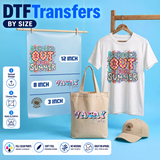
Choose DTF Transfers by Size when you want to upload individual designs, select their dimensions, and order specific quantities.
This is convenient for logos, shirt fronts, backs, sleeves, neck labels, and designs that need to be ordered individually.
Use the DTF Gang Sheet Builder when you want to combine several designs or quantities on one sheet and control how they are arranged.
This is useful for businesses trying to maximize their available sheet space.
Choose Upload-Ready DTF Gang Sheets when you already have a complete gang sheet file prepared at the correct dimensions.
This option is particularly useful for experienced designers and print shops that create their own production layouts.
The biggest benefit of DTF transfers is not simply that they produce colorful prints.
The real advantage for a custom apparel business is flexibility.
DTF can help a business handle different order quantities, complicated artwork, multiple garment styles, repeat jobs, personalization, short production runs, and changing customer demand using one straightforward transfer workflow.
For a growing apparel operation, that flexibility can make it easier to accept more types of jobs without making production unnecessarily complicated.
If you are ready to add DTF to your workflow, compare the available custom DTF transfer ordering methods and choose the option that fits the way your business produces apparel.
Join our newsletter for guides, new designs and shop-growth ideas — a few great reads each month.


Comments (0)
Be the first to leave a comment.
Leave a Comment