





What Are DTF Transfers? A Complete Guide to Direct-to-Film Printing

If you print custom T-shirts, hoodies, workwear, school apparel, or branded clothing, you have probably heard about DTF transfers.
But what exactly are DTF transfers, how do they work, and why have they become such a popular way to decorate apparel?
DTF stands for Direct-to-Film. A design is professionally printed onto a special transfer film, prepared with adhesive, and then applied to a garment using heat and pressure.
The result is a ready-to-press transfer capable of reproducing full-color artwork, fine details, gradients, logos, photographs, and complex designs on many common apparel fabrics.
For apparel businesses, print shops, clothing brands, schools, teams, creators, and hobbyists, DTF transfers provide a flexible way to produce custom apparel without printing every garment directly.
A DTF transfer is a printed design prepared on a specialized film so that it can later be transferred onto fabric with a heat press.
Instead of printing directly onto the shirt, the artwork is produced first as a transfer.
The basic process is:
Once the transfer is professionally produced, the customer does not need a DTF printer. The finished transfer can simply be positioned and heat pressed onto the garment.
This is one of the reasons ready-to-press DTF transfers are popular with custom apparel businesses that want professional prints without operating their own DTF printing equipment.
DTF combines digital printing with a heat-applied adhesive system.
The printer reproduces the artwork on film, including a white ink layer where required. This allows the design to remain bright and visible even when it is applied to dark-colored garments.
After printing, adhesive powder is applied and cured.
The completed transfer can then be stored, shipped, positioned on a garment, and applied with a heat press.
When the correct combination of temperature, time, and pressure is used, the transfer bonds to the fabric.
A final press is typically used after peeling to help produce a finished, durable application.
For detailed application instructions, use Sam's DTF heat press and application guide rather than relying on one universal setting for every garment and transfer.
One of the major advantages of DTF is its flexibility across common apparel fabrics.
DTF transfers are commonly used on:
Different fabrics can react differently to heat.
Polyester, performance fabrics, specialty garments, and heat-sensitive materials may require additional attention to temperature, pressing time, pressure, or testing.
That is why fabric-specific pressing guidance is more useful than assuming every garment should be pressed exactly the same way.
Yes.
DTF printing can include white ink behind the colored artwork, allowing designs to remain visible on both light and dark garments.
This makes DTF especially useful for artwork containing multiple colors, gradients, small details, or logos that must remain consistent across different shirt colors.
Unlike methods that depend on the garment being white or very light, DTF can be used for custom apparel in a broad range of garment colors.
DTF has become popular because it combines print quality with flexible production.
DTF is well suited to designs containing many colors, gradients, photographs, detailed logos, and other complex artwork.
There is no need to separate a design into individual screens simply because it contains multiple colors.
Properly prepared artwork can reproduce small details, thin elements, gradients, and complex graphics that may be difficult or time-consuming with some traditional decoration methods.
Unlike heat-transfer vinyl, a DTF design does not normally require individual vinyl elements to be cut and weeded before application.
That can save considerable preparation time when producing detailed or multi-color designs.
Because each transfer is digitally printed, DTF can work for a single design, short production runs, or larger quantities.
This makes it useful when order quantities frequently change.
Transfers can be produced before the garments are pressed.
A business can keep blank apparel and ready-to-press transfers available and press products as orders arrive rather than decorating every shirt in advance.
With a DTF gang sheet, multiple logos, sizes, or designs can be arranged on one larger sheet.
This can help apparel businesses use available print space efficiently, particularly when several different designs are needed in the same production run.
Buying ready-to-press DTF transfers and owning a DTF printer are two different business models.
Operating a DTF printing system requires printing equipment, inks, film, adhesive powder, curing equipment, maintenance, color management, production space, and knowledge of the printing process.
Ordering transfers allows a business to outsource that production step.
The shop can concentrate on artwork, apparel, customers, sales, and pressing while the transfer manufacturer handles the printing process.
For some high-volume print operations, owning equipment may make sense.
For other apparel businesses, screen printers, embroidery shops, schools, brands, Etsy sellers, and growing custom apparel companies, outsourcing transfers can provide a simpler way to add full-color printing without purchasing another complete print-production system.
Each apparel printing method has situations where it makes sense.
DTF should not be viewed as the only method of decorating apparel.
Screen printing can be very efficient for larger runs of the same design, particularly when the artwork has a limited number of colors.
Heat-transfer vinyl (HTV) can work well for simple names, numbers, lettering, and basic graphics, but complex multi-color artwork can require more cutting, weeding, and layering.
DTG printing prints directly onto the garment and can produce excellent full-color results, but its workflow, equipment, and garment requirements differ from DTF.
Sublimation produces excellent results for suitable polyester products, but it has different fabric and color requirements.
DTF is particularly useful when you need detailed full-color designs, variable quantities, different garment colors, and flexibility across common apparel fabrics.
For businesses deciding between DTF and screen printing, the best choice often depends on order quantity, artwork complexity, number of colors, turnaround requirements, and the equipment already available in the shop.
DTF transfers are used by many different types of customers.
A shop can order transfers and press shirts as customer orders arrive without operating a complete DTF printing system.
Screen-printing businesses can use DTF for jobs that may be inefficient to put on press, including short runs, highly detailed artwork, many-color designs, personalization, and certain rush orders.
Brands can use DTF for logos, graphics, limited releases, samples, and smaller production runs before committing to larger inventory.
DTF can work well when an order includes different garment sizes, styles, names, designs, or quantities.
Businesses already decorating garments can add full-color printed apparel without necessarily adding another complete printing department.
DTF makes it possible to create professional-looking apparel without requiring a large initial order.
There are several ways to order DTF transfers depending on how your artwork is prepared.
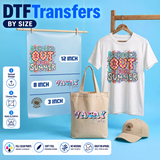
If you have individual designs and know the size needed for each transfer, ordering by size is usually the simplest option.
Upload the artwork, select the transfer dimensions and quantity, and order each design individually.
This is especially convenient when ordering chest logos, shirt fronts, shirt backs, sleeve designs, neck labels, or several designs in different sizes.
A gang sheet builder allows you to arrange multiple designs, quantities, and sizes on a larger sheet.
This can be useful when you want to maximize available sheet space or combine several different designs in one order.
If your complete gang sheet is already designed at the correct dimensions, you can upload the finished file instead of arranging the artwork inside a builder.
This option is commonly used by experienced print shops and designers that already prepare their own production-ready layouts.
Good print quality begins with good artwork.
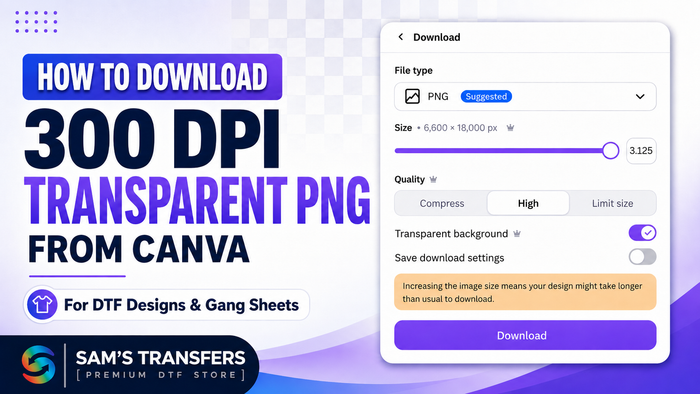
Whenever possible, use clean, high-resolution artwork with a transparent background.
For raster files, 300 DPI at the intended print size is a strong target.
Check small text, thin lines, edges, transparency, and final dimensions before submitting the design.
Do not simply enlarge a small low-resolution image and assume the additional size will create additional detail. The quality of the original artwork still matters.
If you create artwork in Canva, Photoshop, Illustrator, Procreate, or another design program, review the final exported file before ordering.
When you purchase professionally produced ready-to-press transfers, follow the instructions provided with the product.
In most cases, the transfer manufacturer prepares the file correctly for production, so customers should not make unnecessary changes to the artwork unless specifically instructed.
This is especially important when the design contains text, logos, numbers, or directional artwork.
Application is straightforward, but correct pressing matters.
A typical workflow includes:
Poor pressure, incorrect temperature, moisture in the garment, or incorrect pressing time can affect adhesion.
For this reason, use the current pressing instructions provided for your transfers instead of assuming one setting works for every transfer and garment.
A properly produced and correctly applied DTF transfer can provide durable results for custom apparel.
However, durability depends on several factors, including:
Following the recommended pressing and garment-care instructions helps maximize the life of the print.
For more detailed information, see the dedicated DTF transfer durability and washing guide.
The correct size depends on the garment, print location, and desired appearance.
A small left-chest logo needs very different dimensions from an adult full-front or oversized hoodie back.
Instead of automatically using one transfer size for every shirt, consider:
Use the DTF Transfer Size & Placement Guide when choosing transfer dimensions, then order the finished design through DTF Transfers by Size or include it in a gang sheet.
The printing technology is the same.
The difference is primarily how the artwork is arranged and ordered.
An individual transfer is generally ordered as one design at a specified size.
A gang sheet allows multiple designs or repeated copies of designs to share a larger sheet.
Gang sheets are often useful for businesses trying to organize multiple designs, quantities, sizes, logos, neck labels, or customer jobs into an efficient print layout.
DTF can be particularly useful for businesses that need flexibility.
A small apparel business may receive:
Producing all of those jobs with one traditional printing method can be inefficient.
Ready-to-press DTF transfers allow the business to order the designs it needs and press them onto appropriate blank apparel as production requires.
That makes DTF useful not only for hobbyists but also for print shops, apparel brands, schools, organizations, and businesses building a repeat custom-apparel operation.
Sam's DTF Transfers provides three primary ways to order custom DTF transfers:
DTF Transfers by Size for individual designs and quantities.
DTF Gang Sheet Builder when you want to arrange multiple designs and sizes on a gang sheet.
Upload-Ready DTF Gang Sheets when your complete gang sheet file is already prepared.
The right option depends on how your artwork is organized and how much control you want over the gang-sheet layout.
If you are unsure which method fits your order, start with the Custom DTF Transfers ordering page to compare the available options.
DTF transfers provide a flexible way to create professional custom apparel without requiring every apparel business to operate its own DTF printing system.
The process supports detailed, full-color artwork, works across many common apparel fabrics and garment colors, and can be used for anything from a single custom design to high-volume production.
The most important factors are straightforward:
Start with good artwork.
Choose the correct transfer size.
Use a reliable transfer.
Follow the correct heat-press instructions.
And choose the ordering method that fits your production workflow.
Once those pieces are in place, DTF transfers can become a practical part of a custom apparel business, print shop, clothing brand, school program, team store, or creative project.
Join our newsletter for guides, new designs and shop-growth ideas — a few great reads each month.


Comments (0)
Be the first to leave a comment.
Leave a Comment