






5 Times You Should Use DTF Instead of Burning a Screen

As a professional screen printer, your shop is built around the craft of emulsion, ink, mesh, registration, and production efficiency.
There is still nothing wrong with watching an automatic press move through a large repeat order once the screens are registered and production is running.
But customer behavior has changed.
Today’s customers increasingly ask for:
The challenge is not the quality of screen printing.
It is deciding whether a particular job is worth the setup time, screens, labor, and production interruption.
Sometimes, the most profitable decision is to leave the screens in the rack and use ready-to-press DTF transfers instead.
Here are five situations where outsourcing DTF transfers can make more sense for a screen-printing shop.
Every screen printer knows this type of order.
A customer wants:
12 hoodies with a six-color chest logo.
The order itself is small, but the setup is not.
Traditional screen printing may require:
For a larger production run, that setup may be completely justified.
For 12 garments, the setup can represent a large share of the job.
DTF changes the calculation because the artwork is digitally printed without requiring a separate screen for every color.
That makes DTF especially useful for:
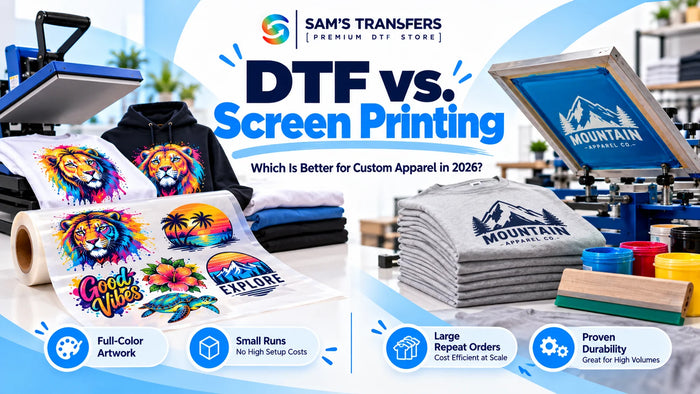
For a broader comparison of the two production methods, see our DTF vs. Screen Printing: Which Is Better for Custom Apparel in 2026? guide.
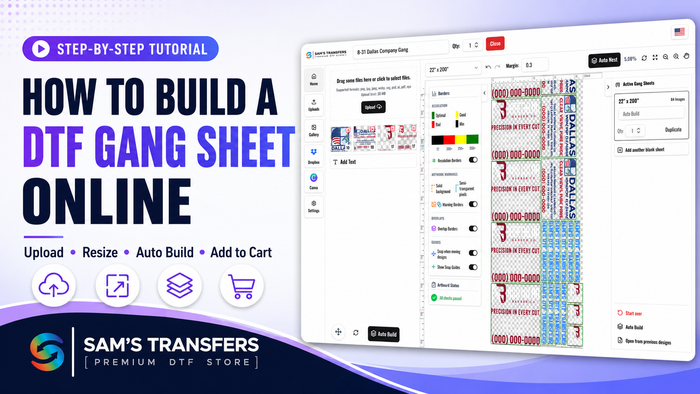
For print shops managing short runs and multiple customer jobs, gang sheets can make outsourced DTF especially efficient.
Depending on the ordering method and sheet size, Sam’s pricing can reach approximately:
Instead of burning several screens for a small multi-color order, you can combine multiple transfers onto a gang sheet and use the available space efficiently.
That does not mean DTF is cheaper than screen printing for every job.
It means you now have another production method available when screen setup would consume too much of the margin.
Screen printing can reproduce impressive artwork, especially in the hands of an experienced separator and printer.
But highly detailed artwork may require significantly more production planning.
Examples include:
These jobs may involve more complicated separations, halftones, mesh decisions, registration, and test printing.
DTF is digitally printed, allowing detailed full-color artwork to be produced without creating an individual screen for every color.
That makes DTF useful when your customer sends artwork that would otherwise turn a small order into a complicated screen-printing job.
For example, a single gang sheet can contain:
all within the same production file.
For shops handling many different small jobs each day, that flexibility can be extremely valuable.
Polyester and performance garments require extra care regardless of the decoration method.
Screen printers already know the challenges:
DTF can provide another option for these jobs, but it should not be treated as a universal solution to dye migration.
The correct pressing conditions still depend on:
For some synthetic garments, using an appropriate DTF transfer and carefully controlled heat-press settings can make production easier than building a dedicated screen-print workflow for a small order.
However, performance fabrics should always be tested before committing to a large production run.
For detailed polyester application guidance, see our DTF Transfers on Polyester: Temperature & Pressing Best Practices guide.
This is especially useful for screen printers who occasionally receive:
Instead of changing your entire production line for a handful of pieces, outsourced DTF can give you another way to complete the job.
Your presses may already be scheduled for large production jobs when a regular customer calls with:
“Can you have these ready tomorrow?”
The problem is not necessarily printing the shirts.
The problem is interrupting an already efficient production schedule.
A small rush order may require you to:
DTF can allow the rush order to move through a separate production path.
At Sam’s DTF Transfers, paid, print-ready weekday orders placed before 2 PM CT can ship the same business day.
Once the transfers arrive, your shop can press the garments without tying up your screen room.
This makes outsourced DTF especially useful for:
For screen printers, the real advantage is not simply fast transfer production.
It is protecting the productivity of your existing screen-printing line.
A customer may be considering a large order but want to see the finished garment first.
Maybe they want:
Burning screens for a single sample can be difficult to justify.
DTF makes this much easier.
You can produce one or several transfers and use them to test:
Once the customer approves the design, you can decide whether the final production run should stay with DTF or move to screen printing.
This is another reason DTF and screen printing work well together.
You do not need to decide that every order must use the same production method.
This is one of the most important points for professional shops.
DTF does not need to replace your screen-printing operation.
It can function as an additional production department.
Consider using screen printing for jobs such as:
Then use DTF for jobs such as:
The result is a shop that can say yes to more types of work without forcing every order through the same production process.
If you want a deeper breakdown of when each production method makes sense, read our DTF vs. Screen Printing comparison guide.
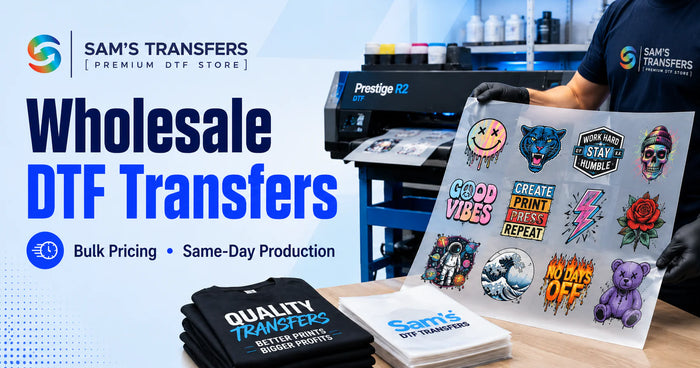
At Sam’s DTF Transfers, we work with screen printers who want to offer DTF without purchasing and maintaining an entire DTF printing system in-house.
You keep control of:
We handle the transfer production.
That gives your shop access to DTF while allowing your screen room to remain focused on the jobs it handles best.
Our DTF Transfers for Screen Printers program is designed specifically for shops that want to outsource transfer production and press garments in-house.
Screen printers generally have two practical gang sheet workflows.
If you have individual artwork files and want to arrange them online, use the Sam’s DTF Gang Sheet Builder.
You can combine different:
on the same gang sheet.
If you already prepare production files in Photoshop, Illustrator, Canva, or other design software, use Upload-Ready DTF Gang Sheets.
This is especially useful for experienced print shops that already manage their own artwork layout and want to control exactly how the sheet is arranged.
Our larger gang sheet options can also provide stronger bulk economics for production shops processing significant transfer volume.
A DTF transfer supplier serving screen printers needs to support a production environment, not just individual hobby orders.
For professional shops, the important factors include:
Hot-peel transfers allow shops to remove the film while the transfer is still hot, helping maintain an efficient pressing rhythm.
Repeat jobs should maintain consistent artwork size, color reproduction, and transfer quality.
Detailed and multi-color artwork can be produced without creating additional screens for every color.
The printing, adhesive application, and curing are completed before the transfers arrive at your shop.
Your production step is applying the transfer to the garment using the correct heat-press settings.
You should be able to move from a few transfers to larger gang sheet quantities without changing the fundamental workflow.
Screen printing remains one of the most efficient production methods in custom apparel.
DTF simply fills some of the gaps.
A large one-color repeat order may belong on your screen-printing press.
A 12-piece order with complex full-color artwork may make more sense with DTF.
A 1,000-piece job may return to screen printing.
A single replacement shirt two weeks later may go back to DTF.
The smartest production decision is not choosing one technology for everything.
It is using the method that protects your time, capacity, and margin on each individual job.
Sam’s DTF Transfers can act as the digital production side of that workflow.
Explore our DTF Transfers for Screen Printers page for print-shop ordering options, or use our Gang Sheet Builder and Upload-Ready Gang Sheets when you are ready to send your next job to production.
Join our newsletter for guides, new designs and shop-growth ideas — a few great reads each month.


Comments (0)
Be the first to leave a comment.
Leave a Comment